Toyota bZ 2027: AWD Electric Powertrain and Charging Updates Future EV Techs Should Know
In Brief: Toyota bZ 2027 Updates
The Toyota bZ 2027 gives future EV technicians a useful look at how electric powertrains, charging hardware, software, and thermal management come together. Canadian AWD models use a 77-kWh battery and produce 338 system horsepower, while charging features include a NACS port, Plug & Charge, battery preconditioning, and CCS/J1772 adapters.
An electric vehicle can turn a routine customer complaint into a lesson involving high-voltage systems, software, thermal management, or charging communication.
The 2027 Toyota bZ is a good example. For students at our auto mechanic school in Surrey, its AWD powertrain and charging technology show how EV service extends well beyond batteries and electric motors.
What is new in the 2027 Toyota bZ?
For Canada, Toyota offers three grades built around front- and all-wheel-drive powertrains, while adding CCS and J1772 charging adapters across the lineup for 2027.
The XLE FWD uses a 57.7-kWh battery, produces 168 system horsepower, and offers up to 380 km of range. AWD models use a 77-kWh battery and produce 338 system horsepower, with the XLE AWD offering up to 468 km of range.
Many of the bZ’s major charging upgrades actually arrived for 2026 and continue into 2027. These include the NACS port, 11-kW onboard AC charger, battery preconditioning, and higher-capacity AWD battery.
For students in our hybrid technology training course, that evolution highlights an important reality: technicians need to know not just what equipment a vehicle has, but how specifications change between model years.
Does the 2027 Toyota bZ have all-wheel drive?
Yes. Toyota Canada offers XLE AWD and Limited AWD versions, both rated at 338 system horsepower.
The Toyota bZ AWD system uses electric propulsion to provide power at both axles. AWD models also feature X-MODE and Grip-Control for additional traction management in challenging conditions.
For future technicians, electric AWD introduces a different diagnostic environment from a conventional mechanical AWD system. Service may involve electric motors, high-voltage components, sensors, control modules, wiring, and software alongside familiar chassis systems.
That makes safe isolation procedures, scan-tool use, wiring diagrams, and manufacturer service information increasingly important skills for anyone preparing to become a hybrid and electric vehicle mechanic.
Does the 2027 Toyota bZ use a NACS charging port?
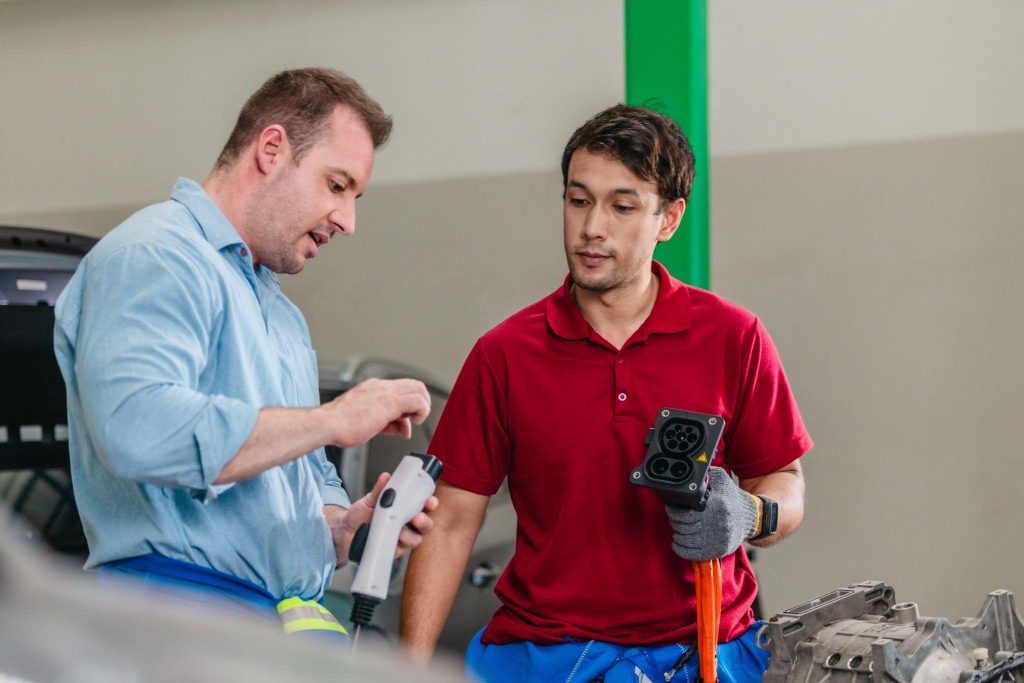
Yes. The Canadian 2027 bZ comes with a North American Charging System port and can access compatible high-speed charging infrastructure. Under ideal conditions, Toyota says DC fast charging can take the battery from 10% to 80% in approximately 30 minutes. The vehicle also supports Level 1 and Level 2 AC charging and includes a dual-voltage charging cable.
The Toyota bZ NACS system is only part of the charging story. Toyota includes CCS and J1772 adapters for 2027, broadening compatibility with other charger types. Plug & Charge can also handle vehicle identification, authentication, and payment authorization automatically at supported networks once appropriately configured.
For technicians, Toyota bZ charging concerns could therefore involve more than the physical connector. Charging performance depends on the vehicle, battery temperature, charging equipment, electronic communication, and software-supported services.

How does battery preconditioning work in the Toyota bZ?
The system warms the high-voltage battery toward an appropriate temperature to help improve DC fast-charging performance in colder conditions.
Toyota explains that the function can be activated manually or automatically when a fast-charging station is entered as the navigation destination. The bZ also uses battery thermal-management hardware to help regulate battery temperature.
That is particularly relevant in a Canadian climate. A customer reporting slow winter charging may not necessarily have a failed battery or charger. Battery temperature, preconditioning, charger capability, and environmental conditions may all need consideration.
Understanding Toyota bZ battery preconditioning therefore introduces future technicians to a broader diagnostic principle. EV performance often depends on the interaction between electrical, thermal, and software-controlled systems.
Would you like to explore training opportunities at our auto mechanic school in Surrey?
Contact ATC Surrey for more information.
Key Takeaways
- The Canadian 2027 Toyota bZ is offered with FWD and AWD powertrains.
- AWD models use a 77-kWh battery and produce 338 system horsepower.
- The XLE AWD has a manufacturer-estimated range of up to 468 km.
- NACS, Plug & Charge, and battery preconditioning continue on the 2027 model.
- CCS and J1772 adapters are included across the Canadian lineup for 2027.
- Toyota bZ battery preconditioning warms the battery to help improve cold-weather DC fast charging.
- These systems show why EV technicians increasingly need skills spanning high-voltage safety, electronics, thermal management, diagnostics, and charging technology.
FAQ
What is new in the 2027 Toyota bZ?
The Canadian lineup offers FWD and AWD powertrains and includes CCS and J1772 adapters for 2027, alongside NACS, Plug & Charge, and battery preconditioning.
Does the 2027 Toyota bZ have all-wheel drive?
Yes. XLE AWD and Limited AWD versions are offered in Canada, producing 338 system horsepower from a 77-kWh battery.
Does the 2027 Toyota bZ use a NACS charging port?
Yes. NACS is standard, while CCS and J1772 adapters provide additional charging compatibility.
How does battery preconditioning work in the Toyota bZ?
It warms the battery toward an appropriate operating temperature to help improve DC fast-charging performance in colder weather.