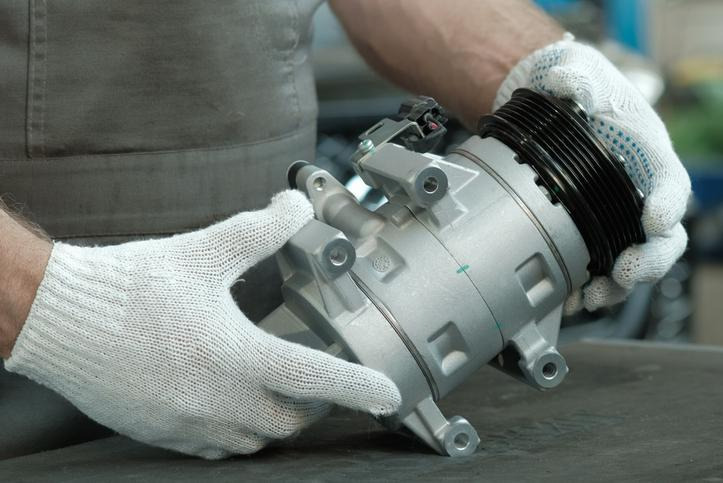
Electric A/C Compressors: High-Voltage Safety and Cooling-System Diagnosis
In Brief: Automotive Air Conditioning in EVs
Electric compressors change how technicians approach automotive air conditioning in hybrid and electric vehicles. Rather than relying on an engine-driven compressor, an EV can use an electrically powered compressor integrated into its high-voltage architecture. Diagnosis may involve refrigerant pressures and temperatures alongside scan data, electrical checks, and thermal-management information. Because some systems also use refrigerant cooling to help manage battery temperature, technicians need to understand the vehicle’s complete thermal architecture before diagnosing a complaint.
Air conditioning may seem like a familiar automotive system, but electrification has changed what technicians can encounter under the hood.
Traditional air conditioning in cars commonly uses a compressor mechanically driven by the engine. Electric vehicles do not have a continuously operating combustion engine to provide that mechanical drive, so many use an electrically powered compressor instead.
For students at our auto mechanic school in Surrey, this creates an important lesson: EV service often combines familiar automotive principles with electrical systems and thermal-management technology. Diagnosing poor cabin cooling, for example, may require technicians to consider refrigerant performance, electronic controls, and high-voltage safety rather than simply checking whether a belt-driven compressor is operating.
How Does an Electric Automotive Air Conditioning Work in an EV?
How does an electric A/C compressor work in an EV? It uses electrical energy to drive the compressor rather than depending on mechanical power from a running internal-combustion engine.
The compressor still performs a fundamental refrigeration-cycle function: circulating and compressing refrigerant so that heat can be transferred through the system. What changes is how the compressor receives its driving power.
This arrangement allows auto air conditioning to operate while an EV is stationary or moving without requiring an engine to run. The Chevrolet Volt, for example, describes an electric air-conditioning compressor operating as part of the vehicle’s high-voltage climate-control system.
This difference is significant for students taking a hybrid technology training course. Familiarity with conventional refrigeration principles remains useful, but technicians must also understand how electrification changes compressor operation and system control.
Why Is an EV A/C Compressor Considered a High-Voltage Component?
On systems where the compressor is supplied by the vehicle’s high-voltage electrical architecture, technicians can encounter electrical hazards that are not present with a conventional belt-driven compressor.
That changes the safety mindset around vehicle air conditioning service.
Technicians should first identify the system they are working on and follow the manufacturer’s service information. Depending on the procedure, this can involve specific high-voltage disabling, isolation, verification, personal protective equipment, and reactivation requirements.
CCOHS guidance on high-voltage battery safety reinforces the importance of manufacturer-specific procedures, hazard identification, and appropriate protective measures when working around electric and hybrid vehicles.
The broader lesson for anyone training to become a hybrid and electric vehicle mechanic is that component identification comes before intervention. An orange high-voltage cable or electrically driven compressor is a reminder that conventional A/C knowledge alone is not sufficient for every electrified vehicle.

What Are the Symptoms of an Electric A/C Compressor Problem?
Drivers may report weak or absent cabin cooling, intermittent cooling, unusual noises, warning messages, or climate-control performance that changes unexpectedly. The difficult part is determining whether the compressor itself is responsible.
A poorly performing automotive air conditioning system can have many possible causes. Depending on vehicle design, technicians may need to consider:
- Refrigerant charge or leakage
- Pressure and temperature readings
- Compressor commands and operating data
- Electrical connections and related circuitry
- Sensors and control modules
- Condenser airflow
- Expansion or refrigerant-control devices
- Stored diagnostic trouble codes
This is where scan-tool information becomes especially valuable. A technician may be able to compare the requested compressor operation with system pressures, temperatures, compressor speed, or other available parameters.
Still, scan data is only part of the diagnosis. A command to operate does not automatically prove that the refrigeration circuit is functioning correctly.
Does an EV Air-Conditioning System Also Help Cool the Battery?
On some EV designs, yes. The refrigerant circuit can interact with a battery thermal-management system to remove heat from the traction battery. This is one of the biggest reasons EV automotive air conditioning should be viewed as part of a wider thermal-management strategy rather than solely a passenger-comfort system.
For example, some EV architectures use the refrigerant circuit for cabin cooling and active traction-battery cooling through a battery chiller. Chevrolet Volt’s battery coolant can interface with the air-conditioning system for pack cooling. However, EV designs vary. Technicians should consult vehicle-specific information rather than assuming every battery and cabin-cooling system operates identically.
Why Does EV A/C Diagnosis Require a System-Wide Approach?
A customer may arrive saying simply, “The A/C isn’t cold.” On an electrified vehicle, the diagnostic picture can be considerably broader. Technicians first need to understand the particular thermal architecture. Is the refrigerant circuit dedicated primarily to cabin cooling? Does it interact with a battery chiller? Does the vehicle use a heat pump? Which sensors and control modules influence compressor operation?
Then comes evidence gathering. Pressure readings, refrigerant temperatures, scan-tool data, compressor operation, electrical information, airflow, and stored fault codes can all contribute to the diagnosis. This interconnectedness is precisely why technicians should resist replacing a compressor solely because cabin cooling has stopped.

What Should Future EV Technicians Remember About A/C Service?
The move toward electrification does not make traditional refrigeration knowledge obsolete. Instead, it adds another layer.
Future technicians still need to understand refrigerant circulation, heat transfer, pressures, temperatures, airflow, and system performance. They also need to know how those fundamentals interact with electronic controls and high-voltage components.
That makes automotive air conditioning an excellent example of how the technician’s role is evolving. A familiar customer complaint can now require knowledge spanning mechanical, refrigeration, electrical, electronic, and thermal-management systems.
Most importantly, safety procedures cannot be treated as an afterthought. Technicians should identify the system, consult manufacturer service information, use the required equipment and procedures, and understand what must be made safe before beginning applicable work.
Would you like to explore training opportunities at our auto mechanic school in Surrey?
Contact us for more information.
Key Takeaways
- EVs can use electrically driven A/C compressors instead of conventional engine-driven compressors.
- Electric compressors connected to the high-voltage system require appropriate safety awareness and manufacturer-specific service procedures.
- Poor auto air conditioning performance does not automatically mean the compressor has failed.
- Diagnosis may involve refrigerant pressures, temperatures, scan data, electrical information, sensors, and airflow checks.
- Some EV thermal architectures use the refrigerant circuit to support traction-battery cooling.
- Technicians should understand the complete thermal-management architecture before diagnosing or servicing an electrified vehicle air conditioning system.
- EV A/C work demonstrates why future technicians need both traditional mechanical knowledge and modern electrical diagnostic skills.
FAQ
How does an electric A/C compressor work in an EV?
An electric A/C compressor uses electrical power to compress and circulate refrigerant rather than being mechanically driven by a running combustion engine. This allows cabin cooling to operate independently of an engine.
Why is an EV A/C compressor considered a high-voltage component?
On vehicles where the compressor is powered from the high-voltage system, it is part of an electrical architecture requiring specific safety precautions. Technicians should always follow vehicle-manufacturer procedures for identification, isolation, servicing, and reactivation.
What are the symptoms of an electric A/C compressor problem?
Possible symptoms include weak or absent cooling, intermittent operation, unusual compressor noise, climate-control warnings, or relevant fault codes. Because other refrigerant, electrical, airflow, and control problems can cause similar symptoms, technicians need to diagnose the system before condemning the compressor.
Does an EV air-conditioning system also help cool the battery?
It can. Some EVs use the refrigerant circuit and a chiller to remove heat from the traction-battery coolant circuit, although thermal-management designs vary between manufacturers and vehicles.