Wheel Speed Sensor Problems: ABS, Traction Control, and Live-Data Clues
In Brief: Wheel Speed Sensor Problems: ABS & Live-Data Diagnosis
- Wheel-speed sensors provide data used by ABS and traction-control systems.
- ABS and traction-control warning lights can appear when wheel-speed information becomes unreliable.
- Live data lets technicians compare individual wheel-speed readings.
- A code does not prove the sensor itself has failed; wiring, contamination, bearing play, or encoder damage can also affect the signal.
An ABS light appears on the dashboard. Moments later, the traction-control warning joins it. A scan reveals a fault associated with one wheel.
Is the wheel speed sensor bad? Possibly, but replacing it immediately can miss the real problem.
Wheel-speed diagnosis is a useful example of evidence-based troubleshooting. The technician can compare fault codes and live readings, then inspect the electrical and mechanical parts responsible for producing the signal. A stored fault does not necessarily identify a defective component.
That diagnostic mindset is an important part of modern auto mechanic training.
What Are the Symptoms of a Bad Wheel Speed Sensor?
Common clues include an illuminated ABS warning light, a stored fault code, incorrect ABS intervention, or problems affecting other systems that depend on wheel-speed information.
The symptoms still do not identify the cause by themselves. HELLA lists wiring breaks, short circuits, contamination, increased wheel-bearing clearance, external damage, and mechanical damage to the encoder wheel among possible sources of trouble.
Can a Wheel Speed Sensor Turn On Both the ABS and Traction-Control Lights?
Yes. Both systems can depend on wheel-speed information, so an unreliable signal can affect more than one function.
This becomes easier to understand during diagnosis. ABS needs to know whether a wheel is approaching lockup during braking. Traction control also uses wheel-speed information when identifying excessive wheel slip. Delphi confirms that an ABS sensor problem can illuminate both ABS and traction-control warning lights.
For students training to become a mechanic, the larger lesson is valuable: one faulty input can influence several interconnected systems.
How Do Technicians Test a Wheel-Speed Sensor With Live Data?
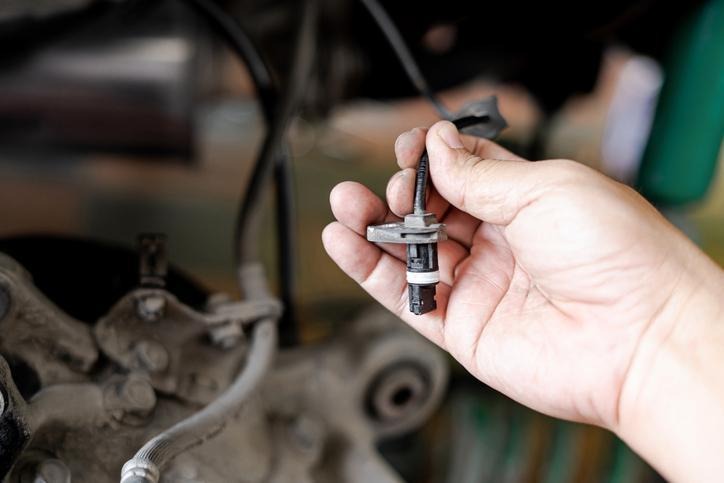
One useful approach is to display the measured values from the individual wheels and compare how their readings behave.
Suppose three wheels report similar speeds while one repeatedly drops out or produces an implausible value. That difference gives the technician a direction for further investigation.
HELLA recommends reading fault memory and comparing the signals or measured values from individual wheel-speed sensors. Its diagnostic example shows how an irregular signal curve at one wheel can be compared with another wheel to narrow down the fault.
That makes wheel speed sensor live data valuable, but it is still one part of the diagnosis. A complete wheel speed sensor test may also involve:
- Inspecting connectors and wiring
- Checking supply voltage where applicable
- Examining the sensor installation area
- Inspecting the impulse or encoder ring
- Using a multimeter or oscilloscope when appropriate for the sensor design
Active and passive sensors operate differently, so technicians need the correct vehicle information and test procedure before taking electrical measurements.
These are the kinds of connections between scan data, electrical testing, and physical inspection that students build through auto mechanic school training.
Can Corrosion or a Damaged Tone Ring Imitate a Sensor Failure?
Yes. The sensor can be functioning while another part of the signal-producing system causes an inaccurate or interrupted reading.
A traditional setup may use a toothed impulse or tone ring, while some active-sensor designs use a multipole magnetic encoder integrated into a wheel-bearing seal. The sensor depends on that component to generate meaningful wheel-speed information.
Dirt or damage can therefore matter. Delphi notes that contamination or damage to the reluctor/tone ring can create an erratic signal or eliminate the signal altogether.
Corrosion or debris around the sensor mounting area can also deserve attention because mounting condition and sensor-to-encoder geometry may affect signal quality on applicable designs. The exact construction and acceptable air gap depend on the vehicle and sensor design.
This is why a wheel speed sensor code should lead to inspection rather than automatic replacement. The code tells the technician where the control system detected a problem. The next job is to find out why.
Are you looking for comprehensive auto mechanic training?
Contact ATC Cambridge for more information.
Key Takeaways
- Wheel-speed data can be shared by ABS, traction control, and other vehicle systems.
- Comparing live readings from multiple wheels can reveal an abnormal signal.
- A sensor-related code does not prove the sensor itself has failed.
- Wiring, contamination, bearing play, mounting problems, and damaged tone or encoder rings can all affect the signal.
- Effective diagnosis combines scan information with electrical and mechanical inspection.
FAQ
What Are the Symptoms of a Bad Wheel-Speed Sensor?
Possible symptoms include an ABS warning light, a traction-control warning, stored fault codes, or incorrect intervention from systems using wheel-speed information.
Can a Wheel-Speed Sensor Turn On Both the ABS and Traction-Control Lights?
Yes. ABS and traction control both use wheel-speed information, so one unreliable signal can affect both systems.
How Do Technicians Test a Wheel-Speed Sensor With Live Data?
Technicians can compare individual wheel-speed readings and look for a wheel that drops out or behaves differently from the others. Further electrical and physical testing can then help identify the cause.
Can Corrosion or a Damaged Tone Ring Imitate a Sensor Failure?
Yes. Contamination, mounting problems, or damage to an impulse, tone, or encoder ring can disrupt the signal even when the sensor itself is not the underlying fault.