
Radiator Fan Problems: Overheating at Idle, A/C Clues, and Electrical Tests
In Brief: Radiator Fan Not Working: Overheating at Idle & Tests
- Overheating mainly at idle can indicate insufficient radiator airflow.
- A radiator fan not working may result from a motor, fuse, relay, wiring, sensor, or control problem.
- Poor A/C performance at idle can provide another airflow clue.
- Technicians test the circuit before deciding which component has failed.
Your temperature gauge climbs while you wait in traffic but settles once the vehicle starts moving. At the same time, the A/C feels noticeably warmer at a stoplight. Those two symptoms can give a technician an important clue.
Cooling fans pull air through the radiator when road speed cannot provide enough airflow. This is particularly important when a vehicle is stationary. If the radiator fan is not working, however, finding the reason requires more than replacing the fan.
At our auto mechanic school in Surrey, students learn to approach symptoms systematically and determine whether a problem is mechanical, electrical, or related to system control.
Why does my car overheat only when idling?
Why does my car overheat only when idling? One possible cause is insufficient airflow through the radiator when the vehicle is stationary.
When driving, vehicle movement pushes air through the radiator. At idle, the cooling fan may need to provide that airflow instead. DENSO explains that cooling fans force air through the radiator to help prevent overheating while a vehicle is stationary.
However, Radiator Fan Problems are not the only explanation. Low coolant, a thermostat problem, restricted coolant flow, radiator problems, or other cooling-system faults can also cause overheating. DENSO notes that a thermostat stuck closed can cause overheating during driving or idling.
The symptom provides a diagnostic direction, not a final diagnosis.
How Do You Know If A Radiator Fan Is Not Working?
Technicians compare the conditions under which the fan should operate with what the fan and its control circuit are actually doing.
Diagnosis may include checking:
- Coolant temperature and scan data
- Fan commands from the control system
- The radiator fan fuse
- Relays or fan-control modules
- Power and ground circuits
- Connectors and wiring
- Fan-motor operation
Modern systems vary considerably. Gates notes that many electric fans use a cooling-fan module that controls fan operation or speed.
Students in our Automotive Service Technician Foundation program learn why understanding the circuit is important before condemning an individual component.
How Do You Test A Radiator-Fan Relay And Fuse?
Technicians first consult the vehicle's wiring diagram and service information, then verify whether the relevant circuit has the required power, ground, control signal, and continuity.
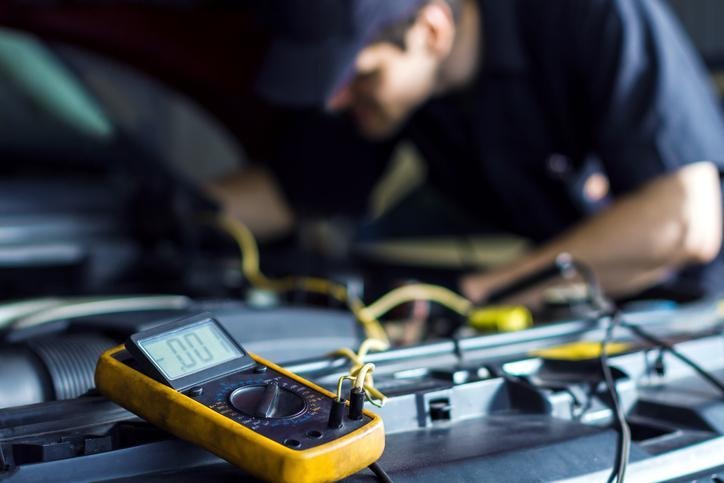
A visual inspection alone may not establish whether a fuse or connection can perform correctly under operating conditions. Electrical diagnosis can therefore involve a multimeter, scan tool, circuit tests, and vehicle-specific procedures.
The radiator fan relay also should not be assumed to be faulty simply because the fan does not run. Depending on the vehicle, the cause could instead involve wiring, a sensor, fan motor, control module, connector, or another part of the command circuit.
Gates notes that damaged fan wiring harnesses may result from poor connections or excessive current draw, further illustrating why the complete circuit matters.
Can a bad radiator fan make the A/C stop cooling at idle?
Yes, on systems that depend on the electric fan for condenser airflow, a fan problem can contribute to poor A/C performance while the vehicle is stationary. Gates identifies poor air-conditioning performance as one possible result when an engine or A/C cooling fan fails to activate or operate efficiently.
Once the vehicle begins moving, natural airflow may improve condenser performance. That makes weak A/C at idle combined with engine-temperature concerns a useful diagnostic clue. Still, technicians should test rather than assume. Refrigerant-system problems, compressor faults, pressure-sensor issues, and other HVAC conditions can also affect cooling.
For students in our auto mechanic course, a cooling fan not working demonstrates why good diagnosis connects symptoms with system operation before parts are replaced.
Would you like to explore training opportunities at ATC auto mechanic school in Surrey?
Contact us for more information.
Key Takeaways
- Cooling fans provide important radiator airflow when a vehicle is stationary.
- Overheating mainly at idle can point toward an airflow problem, but other cooling-system faults remain possible.
- Fan diagnosis can include fuses, relays, wiring, sensors, modules, power, grounds, and the motor itself.
- Poor A/C performance at idle can provide an additional clue on applicable systems.
- Vehicle-specific wiring diagrams and service procedures should guide electrical testing.
FAQ
Why does my car overheat only when idling?
Insufficient airflow through the radiator is one possibility, especially if the cooling fan is not operating. Coolant, thermostat, radiator, and circulation problems should also be considered.
How do you know if a radiator fan is not working?
Technicians determine when the fan should operate and check actual fan operation, scan data, control commands, power, grounds, wiring, fuses, relays or modules, and the fan motor.
How do you test a radiator-fan relay and fuse?
Testing follows the vehicle's wiring diagram and may include checking circuit power, ground, continuity, control signals, and component operation rather than relying only on visual inspection.
Can a bad radiator fan make the A/C stop cooling at idle?
Yes. On applicable systems, insufficient airflow across the A/C condenser can reduce cooling performance at idle, although other HVAC faults can produce similar symptoms.