EV Mechanic Safety: High-Voltage Hazards, PPE, and Safe Work Procedures
TL;DR
EV mechanic safety comes down to three habits you repeat every single time:
- Assume the high-voltage system is live until you’ve shut it down, isolated it, and verified the absence of voltage.
- Use PPE that matches the risk (especially insulated gloves and arc-rated protection when you’re near energized high-voltage components).
- Follow a written, repeatable safe work procedure including lockout/tagout.
If you’re training for the trade (or moving from gas to electrified vehicles), building these routines early is one of the fastest ways to show real EV safety readiness in a shop interview.
Electric vehicles bring new opportunities to the trade, but they also bring new risks. If you’re entering the industry or transitioning from gas-powered vehicles, understanding EV mechanic safety is essential before touching a high-voltage system.
This guide breaks down what technicians need to know about high voltage battery hazards, proper PPE, and safe work procedures.
What Does EV Mechanic Safety Mean for High Voltage Battery Hazards?
EV mechanic safety is the set of skills, habits, and shop controls that prevent injury when you’re servicing hybrid and battery-electric vehicles, especially when the job puts you near the high-voltage (HV) system, the battery pack, or orange high-voltage cabling.
Two facts drive the urgency:
- EVs can store large amounts of electrical energy, and safety guidance for electrified-vehicle incidents explicitly advises: always assume the high-voltage battery and associated components are energized and fully charged until proper disabling and safety steps are completed.
- The risks aren’t only electrical. Guidance also warns that damaged HV batteries can vent/off-gas vapours that are potentially toxic and flammable, and that physical damage can lead to immediate or delayed release of toxic/flammable gases and fire.
Practical translation: EV mechanic safety is about controlling energy (electrical + stored + chemical + thermal). If you’re searching for an auto mechanic school in Cambridge, prioritize programs that build strong shop-safety routines and electrical fundamentals, because that’s the base layer for safe EV work.
What Are the Main Hazard Categories When Working on EVs (Electrical, Chemical, Thermal)?
EV mechanic safety gets simpler when you work from a three-category hazard model.
| Hazard category | What it looks like in a shop | Why it matters | The control strategy that prevents injuries |
| Electrical | Orange HV cables/components; “vehicle awake” risk; stored/stranded energy after damage | Guidance warns that exposed HV components present shock hazards, and stranded energy can remain after incidents. | De-energize using OEM procedures, apply EV lockout tagout, and verify absence of voltage before contact. |
| Chemical | Off-gassing/venting vapours; smoke; irritating | Guidance for odours, note venting/off-gassing vapours can be toxic and flammable, and emissions from lithium-ion events can include hazardous gases (e.g., HF). | Stop work, increase distance, ventilate where safe, and escalate to shop leadership/emergency response protocols. |
| Thermal | Battery heating; fire or re-ignition risk | EMS.gov warns that a damaged HV battery may off-gas or ignite (“thermal runaway”) with little warning; gases/smoke can be highly toxic; battery fires can burn much hotter than ICE vehicle fires. | Treat heat/off-gassing as a stop-work trigger; isolate the area; expect delayed ignition or re-ignition. |
What PPE and Shop Controls Prevent High Voltage Battery Hazards?

EV mechanic safety relies on layers: controls first, PPE second.
Controls to set up before you touch anything:
- Follow the documented OEM safety procedures for the exact make/model/year (shutdown steps and precautions vary).
- Control the work area: boundaries, signage, and limiting access are common requirements in high-voltage safety standards and de-energizing procedures.
- Treat orange HV zones as “no touch” until you’ve verified the system is safe.
PPE that shows up in real EV shop work
- Remove conductive items (rings, watches, chains, metal accessories) before working on an xEV.
- When working on or near battery/energized components, use approved arc-flash flame-resistant clothing; guidance also warns against melt-prone clothing materials during arcing events.
- Use electrically insulated rubber gloves appropriate for the task; referenced standards include IEC 60903 and ASTM D120, with voltage ratings and in-date testing emphasized in safety standards presentations.
Why training changes PPE decisions
Industry frameworks distinguish “awareness” vs “technician” work and emphasize that higher-risk tasks require demonstrated training/competency (e.g., awareness level vs HV technician vs battery technician).
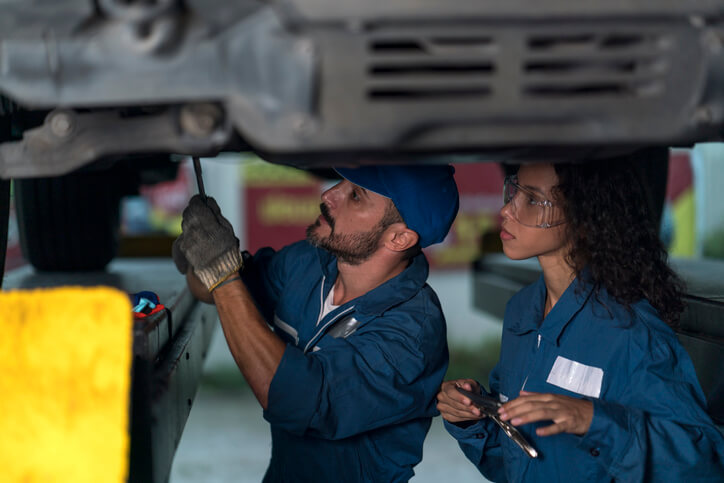
If you’re mapping your next step, an automotive service technician program that emphasizes shop safety, electrical fundamentals, diagnostics, and professional procedures will make EV mechanic safety far easier to learn later.
How Do You Use EV Lockout Tagout and Safe Work Procedures to Prevent Shock and Arc Flash?
EV mechanic safety needs a shutdown process that’s repeatable, even on a hectic day.
Lockout/tagout is the broader safety concept. OSHA describes lockout/tagout as practices and procedures to disable machinery/equipment to prevent the release of hazardous energy during servicing. In Canada, CCOHS describes lockout/tag out as a comprehensive process (not just putting a lock on a switch) and references CSA Z460 definitions for hazardous energy control.
Here’s a shop-friendly EV lockout tagout workflow that aligns with those principles:
EV lockout tagout workflow
- Plan and identify energy sources: locate HV components; pull the OEM shutdown procedure; gather the right PPE and tools.
- Communicate and secure the area: notify affected personnel; set boundaries; keep unauthorized people out.
- Power down and immobilize: safety guidance includes turning the vehicle off and moving keys at least 5 metres away so the vehicle can’t “wake up.”
- Disable low-voltage as required and allow time-outs: disabling guidance includes disconnecting the 12‑volt battery and recognizing that some safety systems may remain active for several minutes.
- Isolate the HV system using the OEM method: only qualified technicians with proper PPE should perform HV shutdown tasks; always reference OEM procedures.
- Apply EV lockout tagout: lock/tag the isolating device and follow the “only the authorized person removes it” principle.
- Verify absence of voltage: safety standards treat testing for absence of voltage as a core step in establishing an electrically safe condition.
- Document and restore power safely: remove LOTO per procedure, notify affected personnel, and follow OEM re-energizing steps.
The point of EV lockout tagout is consistency: it turns “I think it’s off” into “I verified it’s safe.”
What Should an EV Safety Checklist Include Before Beginning Work?
A strong EV mechanic safety checklist has two jobs:
- It prevents contact with a live HV system.
- It flags early warning signs that could indicate EV thermal runaway conditions (or other battery event behaviour) before you commit to hands-on work.
EV mechanic safety pre-work checklist
- Confirm the vehicle is an EV/HEV/PHEV and open OEM service information for HV disabling.
- Do a quick “battery event” scan: leaking fluids, sparks, smoke/vapour, popping/hissing, increased temperature/heat, or strong/irritating odours. Safety guidance treats these as warning signs and emphasizes distance and escalation.
- Clear the area and set boundaries/signage.
- Remove conductive personal items (rings, watches, etc.)
- Inspect PPE: gloves in date and undamaged; use the PPE level that matches the task.
- Complete the OEM shutdown, disable low-voltage as required, and isolate the HV system.
- Apply EV lockout, tagout, and control the key/fob (keep it away so the vehicle can’t re-energize).
- Verify absence of voltage.
- If the vehicle is severely damaged, treat storage/spacing as a safety issue; NHTSA guidance includes standoff recommendations for damaged vehicles with lithium-ion batteries.
One of the most important steps in EV mechanic safety is performing proper EV lockout tagout procedures. This means fully isolating the high-voltage battery, verifying zero voltage, and clearly labelling the vehicle so no one accidentally re-energizes the system. The Canadian Centre for Occupational Health and Safety outlines the fundamentals of lockout and tagout procedures here: CCOHS Lockout/Tagout basics.
If you want to become a mechanic who can keep up with where the industry is going?
Contact ATC today to explore our mechanic courses
Key takeaways
- High voltage battery hazards are predictable when you treat every EV as energized until proven otherwise.
- EV mechanic safety improves fast when PPE is paired with a written de-energizing and verification procedure (not “confidence” or guesswork).
- EV lockout tagout is a full process: plan, communicate, isolate, lock/tag, and verify absence of voltage.
- EV thermal runaway is a chemical + thermal hazard as much as a “fire hazard,” which is why off-gassing and strong odours trigger stop-work and escalation.
FAQ
Q: What are the main hazard categories when working on EVs (electrical/chemical/thermal)?
A: The main EV mechanic safety hazards fall into electrical (shock, arc-flash, and stranded energy), chemical (toxic and flammable off-gassing and battery fire byproducts), and thermal (battery overheating and thermal runaway that can lead to ignition or re-ignition).
Q: What should an EV safety checklist include before beginning work?
A: An EV mechanic safety checklist should include confirming the vehicle type and OEM procedures, controlling the work area, shutting down and isolating the high-voltage system, applying EV lockout tagout, and verifying the absence of voltage. Plus stopping immediately if there are signs of battery damage, off-gassing, smoke, heat, or strong/irritating odours.
Q: What training helps traditional mechanics transition to EV work?
A: The best path is a combination of formal electrical safety awareness/technician training, OEM-specific procedures, and hands-on practice in a controlled lab environment—supported by recognized frameworks such as ASE’s xEV High-Voltage Electrical Safety certifications (Level 1 and Level 2) and skills-based standards for isolating and re-energizing HV systems.