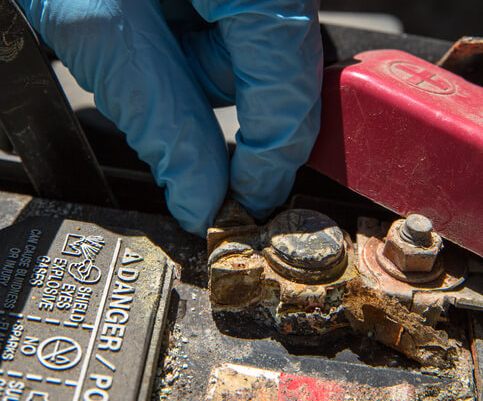
Battery Cable Voltage Drop: Corrosion, Resistance, and Slow-Crank Clues
In Summary: Battery Cable Voltage Drop Test
- Corroded or damaged cables can restrict current and contribute to slow cranking.
- A battery cable voltage drop test checks resistance while the starter circuit is under load.
- Technicians test both the positive and ground sides of the circuit.
- Acceptable voltage drop varies by vehicle and test point, so service specifications come first.
The engine cranks slowly, so the battery must be weak, or perhaps the starter is failing. Those are possibilities, but there is another part of the circuit worth investigating: the cables connecting them.
Corrosion, loose connections, damaged conductors, and poor grounds can introduce resistance that reduces the voltage available to the starter. A battery cable voltage drop test helps technicians find that resistance while the circuit is actually working.
For students at our auto mechanic school, this is an important lesson in testing the complete circuit before replacing components.
What Is A Battery Cable Voltage Drop Test?
What is a voltage-drop test? It measures how much voltage is lost across a cable, connection, switch, or other part of a circuit while current is flowing.
Starter circuits carry high current, making small amounts of unwanted resistance significant. A technician places a voltmeter across the section being tested and cranks the engine. The meter shows the voltage being lost across that section.
This makes a voltage drop test particularly useful for finding resistance that may not be obvious during a visual inspection. Voltage-drop testing can locate excessive resistance in starter-system wires, cables, solenoids, switches, and connections.
How Do You Test Battery Cables For Excessive Resistance?
Technicians measure voltage loss across the positive and negative sides of the starting circuit while the circuit is under load.
On the positive side, the meter can be connected between the battery positive terminal and the starter-side connection. The ground side can be checked between the starter housing or engine and the battery negative terminal.
If excessive drop appears, smaller sections can then be tested to isolate the problem. DENSO specifies checking the battery terminal-to-clamp connection, positive cable, magnetic switch, negative cable, and starter-to-engine connection separately.
Learning how to test battery cables this way helps students in our automotive training move from a general symptom to a specific circuit fault.
Can Corroded Battery Cables Cause Slow Cranking?
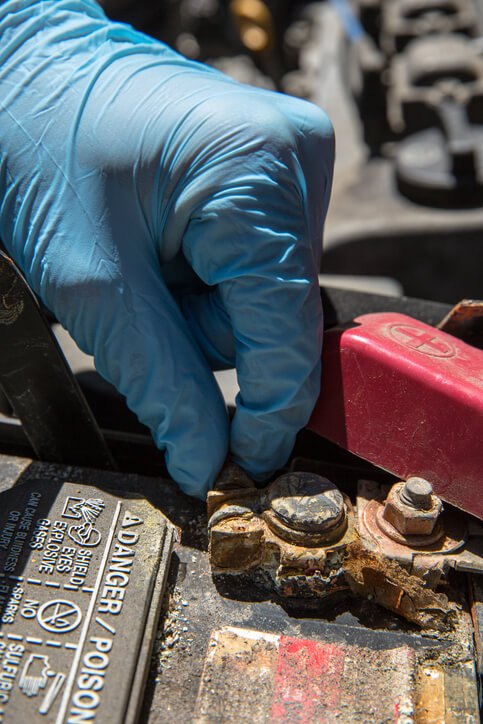
Yes. Corrosion or poor connections can increase resistance, reducing the current available to the starter and causing it to turn the engine more slowly. DENSO identifies corroded or dirty battery connections and high circuit resistance among conditions that can make a starter turn too slowly.
Corrosion may be visible at a battery terminal, but resistance can also occur at grounds, starter connections, or within a damaged cable. That is why cable resistance belongs on the list of slow crank causes alongside battery condition, starter problems, and mechanical factors such as increased engine drag.

What Voltage Drop Is Acceptable In A Starter Circuit?
There is no single limit that should replace the vehicle manufacturer's specifications because acceptable values depend on the circuit and test points.
As a technical example, DENSO gives limits of 0.2 V or less across an individual positive battery cable and 0.2 V or less on the negative side in its starter troubleshooting procedure. Its overall positive-side diagnostic threshold is 0.5 V or less.
Ford service information for specific applications similarly specifies 0.2 V or less for the starter ground circuit.
These numbers are useful for understanding the principle, but future technicians should always consult the service information for the vehicle being tested.
For students considering auto careers, voltage-drop testing illustrates a broader diagnostic habit: test where electrical energy is being lost rather than assuming the most obvious component is responsible.
Would you like to explore training opportunities at our auto mechanic school?
Contact ATC Toronto for more information.
Key Takeaways
- Battery cables and connections can cause slow cranking even when the battery and starter are serviceable.
- Voltage-drop testing evaluates a circuit while current is flowing.
- Both the positive supply and negative ground paths should be checked.
- Excessive resistance may come from corrosion, loose connections, damaged cables, or poor grounds.
- Test individual circuit sections to isolate where voltage is being lost.
- Use manufacturer specifications when deciding whether a reading is excessive.
FAQ
What is a voltage-drop test?
A voltage-drop test measures voltage lost across part of an electrical circuit while current is flowing, helping technicians locate excessive resistance.
How do you test battery cables for excessive resistance?
Technicians connect a voltmeter across the cable or circuit section and measure voltage drop while the starter is operating. If the reading is excessive, they test smaller sections to locate the resistance.
Can corroded battery cables cause slow cranking?
Yes. Corrosion can increase electrical resistance and reduce the current available to the starter, contributing to slow or unsuccessful cranking.
What voltage drop is acceptable in a starter circuit?
It depends on the vehicle and test point. Some technical procedures use approximately 0.2 V or less for individual battery cables, but technicians should follow the manufacturer's specifications for the vehicle being diagnosed.