AWD Tire Matching: Why Tread Depth Differences Matter to Modern Drivetrains
In Brief: AWD Tire Replacement and Why Equal Tread Depth Matters
AWD tire replacement requires more care than simply finding another tire with the same size printed on the sidewall. As tires wear, their rolling circumference changes. Significant differences between tires can make some AWD drivetrains respond as though wheels are rotating at different speeds, potentially increasing workload on drivetrain components. Technicians therefore measure all four tires, compare specifications, check pressure and wear, and follow the vehicle manufacturer’s allowable tread-depth or circumference limits before deciding whether one, two, or all four tires should be replaced.
One damaged tire can create a surprisingly complicated decision on an all-wheel-drive vehicle.
If three tires have already accumulated substantial wear and the fourth develops an unrepairable puncture, installing one brand-new tire may leave that corner with noticeably deeper tread and a slightly different rolling circumference.
For students at our auto mechanic school in Surrey, this is a useful example of why technicians need to look beyond the failed component. A proper AWD tire replacement recommendation considers the complete set of tires and the drivetrain they serve.
Do All Four Tires Need to Match on an AWD Vehicle?
Do all four tires need to match on an AWD vehicle? In general, AWD vehicles should use tires that closely match the vehicle manufacturer’s requirements for size, type, construction, and rolling characteristics.
Michelin recommends matching all four tires for size, brand, model, and rolling radius on four-wheel-drive vehicles when the manufacturer does not provide different instructions. It also advises against mixing categories such as all-season, all-terrain, and winter tires.
Vehicle manufacturers can be even more specific. Toyota, for example, warns owners of certain 4WD vehicles not to mix tires of different makes, models, tread patterns, or treadwear.
Why does treadwear matter?
A worn tire has a smaller effective diameter than the same tire when new. That means it may need to rotate slightly more often to travel the same distance. A sufficiently large AWD tire tread difference can therefore create persistent wheel-speed differences even when all four wheels are travelling straight ahead.
Can You Replace Only One Tire on an AWD Car?
Sometimes, but only when the replacement satisfies the vehicle manufacturer’s requirements and closely matches the remaining tires. Technicians should not assume that one-tire replacement is either always acceptable or always prohibited.
Michelin states that replacing a single tire on an AWD or 4WD vehicle requires special care because differences in tire circumference can place stress on drivetrain components. It recommends consulting manufacturer guidance before proceeding.
For some applications, a replacement tire that matches the remaining tires closely enough may be acceptable. In other situations, technicians may recommend replacing additional tires so that tread depths and rolling circumferences remain within the manufacturer’s permitted range.
This is why the question replace one tire on AWD cannot be answered reliably from the vehicle’s drive type alone. Students in our Automotive Service Technician Foundation program learn to measure first and consult service information rather than treating every AWD system the same.
AWD Tire Replacement: How Much Tread-Depth Difference Is Safe?
There is no universal number that applies to every AWD vehicle. That is one of the most important points future technicians should understand.
Different manufacturers and drivetrain designs may specify different maximum differences in circumference, tread depth, or revolutions per mile. The vehicle owner’s manual or manufacturer service information should therefore determine the allowable limit.
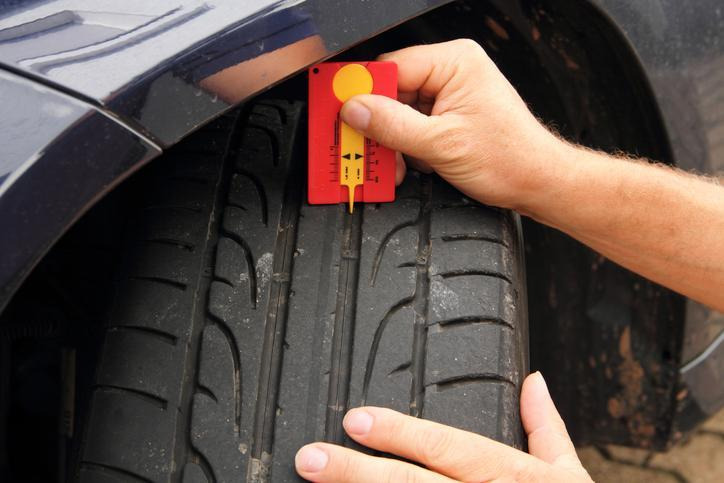
Michelin offers a general fallback guideline of up to 5/32 inch tread-depth variation for matched tires on four-wheel-drive vehicles when this does not conflict with vehicle-manufacturer recommendations. However, that figure should not be treated as a universal AWD specification.
A technician may use a tire tread depth gauge to record the remaining tread at multiple locations on each tire and compare those readings. Tire brand and model matter too, because two tires bearing the same nominal size can have different actual rolling characteristics.
Pressure must also be checked. Michelin notes that tire rolling radius is sensitive to inflation pressure, so an underinflated tire can introduce another rolling difference even when tread depths are similar.
Can Mismatched Tires Damage an AWD System?
Significant differences in rolling circumference can place additional stress on some AWD drivetrains over time. An AWD system is designed to manage differences in wheel speed that occur naturally, for example, when the vehicle turns. But a permanent difference caused by mismatched tire circumference can create a different operating condition.
Depending on drivetrain design, components such as centre differentials, couplings, transfer units, or electronically controlled clutch systems may have to compensate more frequently. Michelin specifically warns that even relatively small circumference differences can place stress on AWD drivetrain components and recommends following manufacturer limits.
That does not mean every minor tread difference instantly damages the drivetrain. The concern is whether the tires fall outside the specifications the system was designed to tolerate. This is why technicians should avoid alarming customers with blanket statements while still treating mismatched tires in AWD applications seriously.
Why Does AWD Tire Rotation Matter?
Regular AWD tire rotation can help maintain more even wear among the four positions when the vehicle manufacturer recommends rotation.
Front and rear tires often experience different loads. Steering, braking, drivetrain torque, alignment settings, and suspension geometry can all contribute to different wear rates.
If those differences accumulate, a set that began with matching tread depths can gradually develop increasingly uneven circumferences.
Rotation cannot fix abnormal wear caused by alignment, inflation, suspension, or mechanical problems, so technicians should inspect the tread patterns as well as move the tires.
Students completing our auto mechanic course can therefore view rotation as part of a larger maintenance strategy: monitor tread depth, pressure, wear patterns, and manufacturer requirements throughout the life of the tire set.
What Do Technicians Check Before Recommending Replacement?
Before recommending whether one or more tires should be replaced, technicians can gather several pieces of information:
- Remaining tread depth on all four tires
- Tire size
- Brand and model
- Construction and type
- Load and speed ratings
- Inflation pressure
- Wear patterns
- Evidence of damage
- Vehicle-manufacturer tread or circumference limits
They should also determine whether the existing tires are otherwise serviceable. If only one tire is damaged but the remaining three are already close to replacement, replacing the complete set may make more sense than trying to match one new tire to heavily worn ones.
If the other three remain relatively new and comfortably within the manufacturer’s permitted difference, a matched single replacement may be possible. That is the real lesson behind AWD tire matching: the correct recommendation comes from measurements and specifications rather than a one-size-fits-all rule.
Would you like to explore training options at our auto mechanic school in Surrey?
Contact us for more information.
Key Takeaways
- AWD tire replacement should account for all four tires, not only the damaged one.
- AWD vehicles generally benefit from closely matched tire size, type, model, and rolling circumference.
- As tread wears, tire circumference changes.
- There is no single universally safe AWD tire tread difference; manufacturer requirements take priority.
- Replacing one tire may be possible on some vehicles when its specifications and remaining tread closely match the other three.
- Significant rolling-circumference differences can place additional stress on some AWD drivetrain components.
- Proper inflation matters because tire pressure also affects rolling radius.
- Regular rotation can help promote more even wear when performed according to vehicle-manufacturer recommendations.
FAQ
Do all four tires need to match on an AWD vehicle?
They should closely follow the vehicle manufacturer’s specifications for size, type, construction, and rolling characteristics. Some manufacturers also require close matching of brand, model, tread pattern, and treadwear.
Can you replace only one tire on an AWD car?
Sometimes. The new tire must meet the manufacturer’s requirements and may need to closely match the remaining tires in specification, tread depth, and rolling circumference. Always check vehicle-specific guidance.
How much tread-depth difference is safe on AWD tires?
There is no universal tolerance. Manufacturers may specify different tread-depth or circumference limits, so technicians should use the specifications for the particular vehicle. Michelin’s general guidance should only be used when it does not conflict with OEM instructions.
Can mismatched tires damage an AWD system?
Tires with substantially different rolling circumferences can increase stress on some AWD drivetrain components because the system may continuously compensate for wheel-speed differences. The acceptable variation depends on vehicle design.